
Last updated: November 2026. Examples are estimates for education – your card’s statement shows your exact minimum.
That small “minimum payment due” box on your statement is designed to feel painless. It isn’t. Searches like “how to calculate your minimum credit card payment” and “how long to pay off a credit card with minimum payments” are popular for a reason: the real cost is hidden in the time. This guide explains the formulas issuers use, shows what a $5,000 balance costs under different payment strategies, and tests whether a balance transfer is worth the fee. Run your own numbers with our credit card minimum payment calculator as you go.
- The Federal Reserve reports the average APR on card accounts that were charged interest was 22.15% in Q2 2026.
- On a $5,000 balance at that rate, paying only the minimum (1% + interest) takes about 19 yrs 3 mo and costs $8,159 in interest.
- Paying a fixed $300 a month clears it in 21 months for $1,031 in interest.
- A balance transfer with a 3% fee and 0% for 18 months could cut total cost to about $150 – if you pay it off before the promo ends.
- How credit card minimum payments are calculated
- What’s the average credit card interest rate in 2026?
- How long does it take to pay off $5,000 with minimum payments?
- Is a balance transfer worth it?
- Which debt should you pay first?
- How credit card interest is actually charged
- What your first six months of minimum payments look like
- How to pay off credit card debt faster
- Balance transfer pitfalls to avoid
- Frequently asked questions
How credit card minimum payments are calculated
There’s no single federal formula, but according to NerdWallet’s explainer, most issuers use one of two methods:
- Flat percentage: usually about 2% of the statement balance (so $10,000 → $200). Most common among credit unions and subprime issuers, per CFPB research cited by NerdWallet.
- Percentage plus interest and fees: about 1% of the balance, plus that month’s interest and any fees (e.g., $10,000 × 1% = $100, + $160 interest + $41 late fee = $301). Most common among large issuers.
If your balance is small (typically under about $1,000), the minimum is usually a fixed floor such as $25 or $40; if your balance is below the floor, you owe the whole balance. Past-due amounts can be added on top. Our guide to how credit cards work explains billing cycles, grace periods and APR in more detail.
Minimum payment examples at 22.15% APR
| Balance | Flat 2% method | 1% + interest method | Monthly interest alone |
|---|---|---|---|
| $500 | $25.00 | $25.00 | $9.23 |
| $1,000 | $25.00 | $28.46 | $18.46 |
| $2,500 | $50.00 | $71.15 | $46.15 |
| $5,000 | $100.00 | $142.29 | $92.29 |
| $10,000 | $200.00 | $284.58 | $184.58 |
Illustration only: your issuer’s formula and floor may differ. Check your statement or card agreement.
What’s the average credit card interest rate in 2026?
The Federal Reserve’s G.19 Consumer Credit release (September 8, 2026) shows commercial bank credit card APRs by quarter:
| Quarter | All accounts | Accounts assessed interest |
|---|---|---|
| Q2 2026 | 20.94% | 22.15% |
| Q1 2026 | 21.00% | 21.52% |
| Q4 2025 | 20.97% | 22.30% |
| Q3 2025 | 21.39% | 22.83% |
| Q2 2025 | 21.16% | 22.25% |
“Accounts assessed interest” are cards that actually carried a balance – the rate that matters if you’re paying down debt. We use 22.15% in the examples below.
How long does it take to pay off $5,000 with minimum payments?
| Strategy | First payment | Time to pay off | Total interest | Total paid |
|---|---|---|---|---|
| Minimum only (1% + interest, $25 floor) | $142.29 | 19 yrs 3 mo | $8,159 | $13,159 |
| Fixed $200 per month | $200.00 | 2 yrs 10 mo | $1,768 | $6,768 |
| Fixed $300 per month | $300.00 | 1 yr 9 mo | $1,031 | $6,031 |
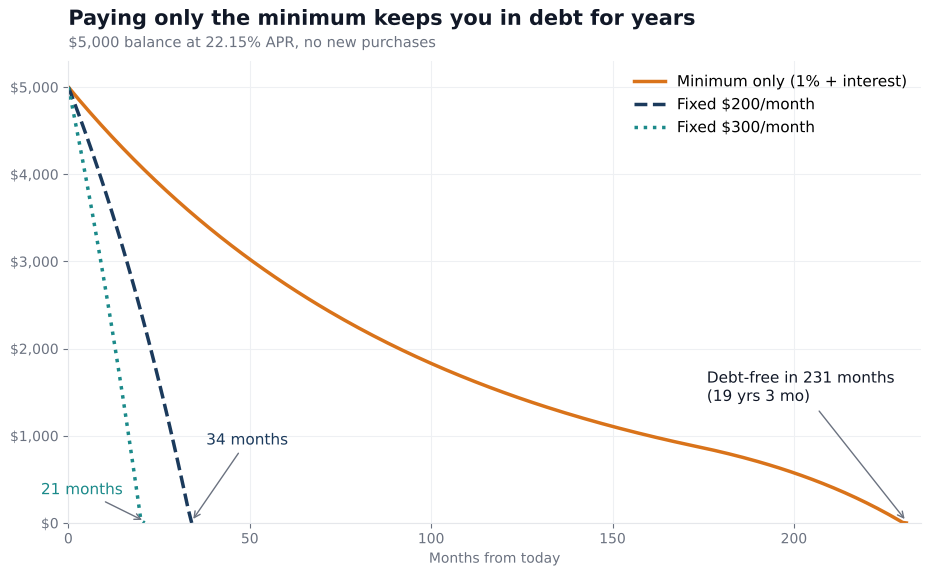
The minimum-payment approach feels cheap at first (about $142.29 in month one), but because the payment shrinks as the balance shrinks, it drags on for 19 yrs 3 mo. Note that at a 22.15% APR, about 1.85% of your balance is charged as interest every month, so a payment of only 2% of the balance would barely touch the principal – one reason many large issuers add interest on top of the percentage. Paying a fixed amount instead of the shrinking minimum is the single easiest fix. See your own payoff timeline in the minimum payment calculator.
Is a balance transfer worth it?
A balance transfer moves your debt to a card with a 0% introductory APR. The catch is the transfer fee: per NerdWallet, it typically costs 3% to 5% of the amount moved (a $5,000 transfer at 5% costs $250), and promotional 0% periods of 15 to 18 months are common examples. Fee-free cards exist but are less common, and are more likely at credit unions and community banks.
| Scenario ($5,000, $300/month) | Transfer fee | Interest paid | Total cost | Payoff time | Saved vs. no transfer |
|---|---|---|---|---|---|
| No transfer, $300/month | $0 | $1,031 | $1,031 | 21 months | — |
| 3% fee, 0% for 18 months | $150 | $0 | $150 | 18 months | $881 |
| 5% fee, 0% for 18 months | $250 | $0 | $250 | 18 months | $781 |
| 3% fee, 0% for 15 months | $150 | $20 | $170 | 18 months | $861 |
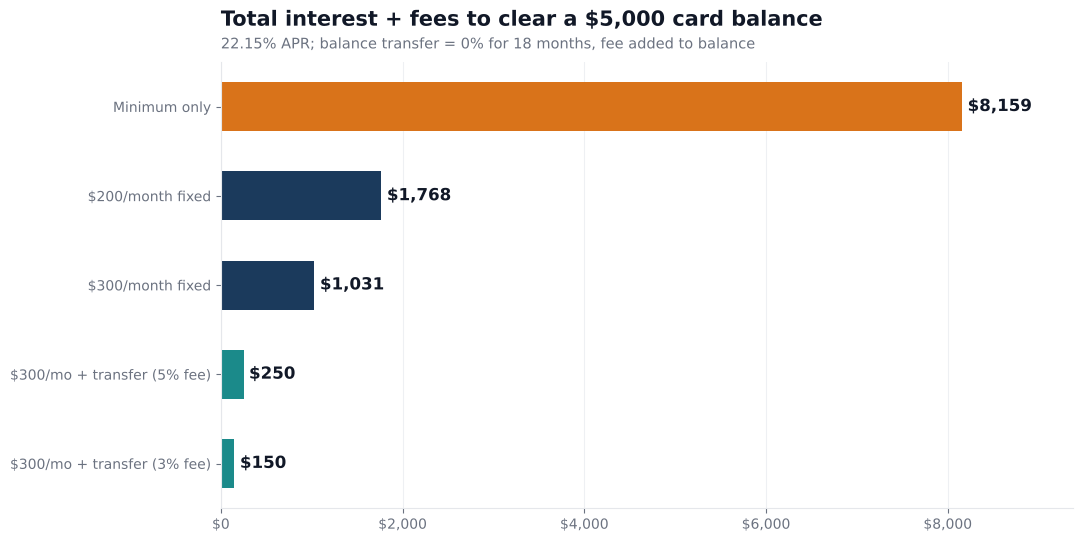
The math is simple: a transfer wins when interest saved > transfer fee. The key is a payoff plan – $5,000 plus a 3% fee is $5,150, so $300 a month clears it in about 18 months, right before the promo ends. If you can’t pay it off in time, the leftover balance is hit with the card’s regular APR. Test your own fee, promo length and payment in our balance transfer calculator.
Balance transfer checklist
- Calculate the fee in dollars first.
- Divide the new balance by the promo months to get your required monthly payment.
- Don’t add new purchases to the old card.
- Set autopay so one late payment doesn’t end the promo rate.
Which debt should you pay first?
If you have several cards, choose a method and stick to it. The debt snowball vs. debt avalanche comparison breaks down the trade-offs: avalanche (highest APR first) saves the most interest, snowball (smallest balance first) builds momentum. Looking at the bigger picture? See our debt hub and check your debt-to-income ratio, which lenders use when you apply for new credit.
How credit card interest is actually charged
Most cards convert your APR to a daily rate and apply it to your balance each day of the billing cycle. At 22.15%, the daily rate is about 0.0607% (22.15% ÷ 365), which works out to roughly $3.03 a day on a $5,000 balance – about $91.03 over a 30-day cycle. Paying your full statement balance by the due date avoids this interest on purchases through the grace period; carrying a balance does not. Our guide on how credit cards work covers grace periods in detail.
What your first six months of minimum payments look like
The table shows why the minimum payment barely moves your balance. Notice how most of each payment is interest:
| Month | Starting balance | Interest charged | Minimum payment | Goes to principal | Ending balance |
|---|---|---|---|---|---|
| 1 | $5,000.00 | $92.29 | $142.29 | $50.00 | $4,950.00 |
| 2 | $4,950.00 | $91.37 | $140.87 | $49.50 | $4,900.50 |
| 3 | $4,900.50 | $90.46 | $139.46 | $49.00 | $4,851.49 |
| 4 | $4,851.49 | $89.55 | $138.07 | $48.51 | $4,802.98 |
| 5 | $4,802.98 | $88.66 | $136.68 | $48.03 | $4,754.95 |
| 6 | $4,754.95 | $87.77 | $135.32 | $47.55 | $4,707.40 |
After six months you have paid roughly $833 but reduced the balance by only $293. That is the minimum payment trap in numbers.
How to pay off credit card debt faster
You do not need a huge budget change. A small, fixed addition to the minimum makes a large difference:
| Strategy | Time to pay off | Total interest | Interest saved |
|---|---|---|---|
| Minimum only | 19 yrs 3 mo | $8,159 | — |
| Minimum + $50 | 5 yrs 7 mo | $2,849 | $5,309 |
| Minimum + $100 | 3 yrs 4 mo | $1,779 | $6,380 |
Other practical moves:
- Pay a fixed amount instead of the shrinking minimum, as shown earlier.
- Send windfalls (tax refunds, bonuses) straight to the card. Estimate yours with the tax refund calculator.
- Ask your issuer for a lower APR. It is not guaranteed, but it costs nothing to ask.
- Compare a personal loan. A fixed-rate loan can replace a revolving balance; test it in the loan calculator and compare offers in the loan comparison calculator.
- Pick a payoff order. See the snowball vs. avalanche comparison.
Balance transfer pitfalls to avoid
- Forgetting the fee. Add 3%–5% to your balance before you plan payments.
- Missing the deadline. Any balance left when the 0% period ends accrues interest at the regular APR.
- Late payments. Many issuers can end a promotional rate after a late payment; read the terms.
- Credit limit. You can usually only transfer up to your new limit, minus the fee.
- Same-issuer limits. Issuers often do not allow transfers between their own cards.
- New spending. Purchases on the new card may not get the 0% rate. Check the terms.
Who should consider a transfer?
A transfer tends to make sense if you have a good enough credit score to qualify, a balance you can realistically pay off within the promo window, and a fee that is much lower than the interest you would otherwise pay. If you cannot pay it off in time, a fixed-rate loan or a stricter payoff plan may fit better.
Frequently asked questions
How do I calculate my minimum credit card payment?
Check which method your issuer uses: roughly 2% of the balance, or about 1% of the balance plus the month’s interest and fees – with a floor like $25–$40. The calculator lets you test both.
How long will it take to pay off my card with minimum payments?
For $5,000 at 22.15% with a 1% + interest minimum, about 19 yrs 3 mo. Your statement includes a Minimum Payment Warning with your exact timeline.
Does a balance transfer hurt my credit?
Applying creates a hard inquiry, and a new card changes your utilization and average account age. Paying the debt down on time generally helps over the long run.
What happens when the 0% period ends?
Any remaining balance starts accruing interest at the card’s regular APR. Plan to clear it before then.
Is it better to pay more than the minimum?
Yes. Even a modest fixed payment shortens payoff by years and cuts interest by thousands in the example above.
Why is my minimum payment different every month?
If your issuer uses a percentage of the balance, the minimum falls as your balance falls, and it rises when interest, fees or past-due amounts are added.
Is it bad to only pay the minimum?
It keeps your account in good standing, but it maximizes interest. In our $5,000 example it costs about $8,159 in interest and takes more than 19 years.
Can I pay my card more than once a month?
Yes. Extra payments reduce your balance sooner, which can lower the interest charged on the average daily balance.
- Credit Card Minimum Payment Calculator – see your payoff date
- Balance Transfer Calculator – is the fee worth it?
- All Credit Card Calculators – full toolkit
- How Do Credit Cards Work? – the basics explained
- Debt Snowball vs. Avalanche – pick a payoff strategy
- Debt-to-Income Ratio Calculator – see how lenders view you
- Loan Calculator – consider a personal loan
- Loan Comparison Calculator – compare consolidation offers
Sources & methodology
Payoff simulations assume monthly compounding at APR ÷ 12, no new purchases, no late fees, and the stated minimum rules. Rates: Federal Reserve G.19 (Sept. 8, 2026). Formulas and fee ranges: NerdWallet minimum payments and balance transfer fees. See how we calculate. Educational only – not financial advice.