
Last updated: November 18, 2026. Rates change daily – confirm with the bank before opening any CD.
A certificate of deposit (CD) is one of the simplest ways to earn a guaranteed return: you lock in money for a set term, the bank pays a fixed rate, and you get your principal plus interest at maturity. But how much will a CD actually earn? This guide explains the formula behind every CD calculator, gives worked examples for 6-, 12-, 18- and 60-month terms, and compares today’s national average rates with the best rates on the market. Want to run your own numbers? Use our CD calculator.
- Bankrate’s Nov 18, 2026 survey shows the national average 1-year CD at just 2.13% APY, while top 1-year offers reach 4.65%.
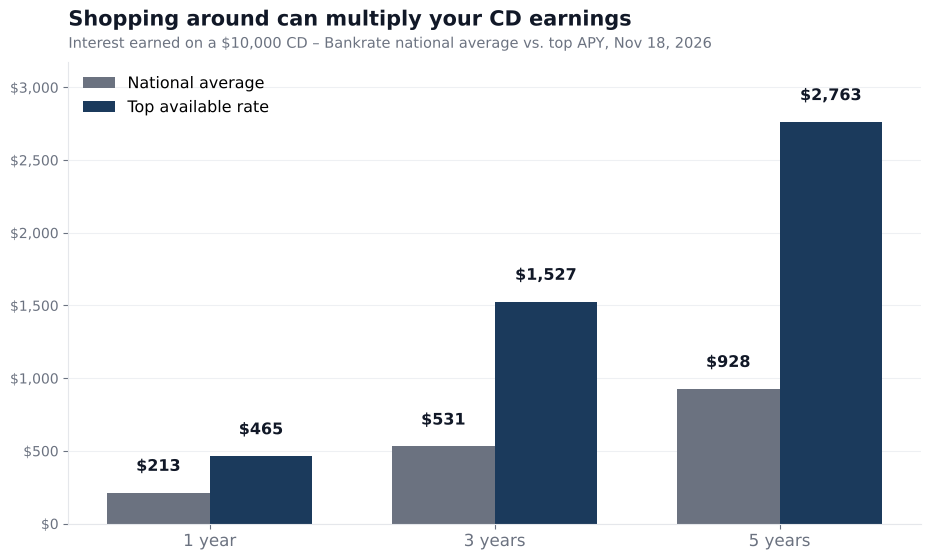
- On $10,000, that’s $465.00 vs. $213.00 in one year – a $252.00 difference.
- Rates are set by the bank, not your city: online CDs generally pay the same whether you live in New York, Miami or San Francisco.
- CDs at FDIC-insured banks (or NCUA-insured credit unions) are protected up to $250,000 per depositor, per institution, per ownership category.
- How CD interest is calculated
- CD rates today: national average vs. best available
- How much will a $10,000 CD earn?
- 6-, 8-, 12-, 18- and 24-month CD calculator examples
- Do CD rates vary by city or state?
- Types of CDs to know
- CD vs. savings account
- Step-rate CD example: compare the blended APY
- Building a simple CD ladder (with real numbers)
- Early withdrawal penalties: what could it cost?
- Taxes on CD interest
- CD vs. other places to keep your cash
- How to choose a CD: a 7-point checklist
- Frequently asked questions
How CD interest is calculated
CDs quote an APY (annual percentage yield), which already includes compounding. To find your earnings over any term:
Interest = Deposit × [(1 + APY)months ÷ 12 − 1]
Example: $10,000 at 4.65% APY for 12 months → $10,000 × (1.0465 − 1) = $465.00. For a 6-month CD you use months ÷ 12 = 0.5 as the exponent.
APY vs. APR: why the difference matters
If a bank advertises a 4.60% interest rate compounded daily, the APY is slightly higher – about 4.71% – because you earn interest on interest. Compounded monthly it’s 4.70%. Always compare CDs using APY, and see how compounding frequency changes growth in our compound interest calculator.
CD rates today: national average vs. best available
According to Bankrate’s November 18, 2026 survey, the best CD rates are more than double the national average:
| Term | National average APY | Top available APY |
|---|---|---|
| 1 year | 2.13% | 4.65% |
| 2 years | 1.90% | n/a in source |
| 3 years | 1.74% | 4.85% |
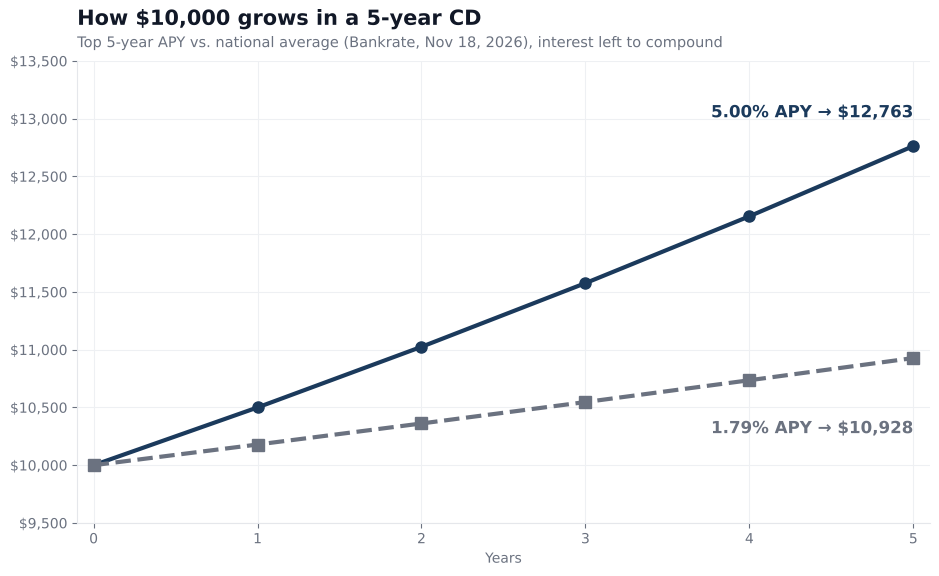
| 5 years | 1.79% | 5.00% |
Bankrate also listed top rates of 4.30% (3-month) and 4.50% (6-month); it showed no 2-year top rate. Averages are survey figures; individual offers vary by bank and minimum deposit, so confirm on Bankrate before you buy.
How much will a $10,000 CD earn?
| Term | Avg APY | Earnings at average | Top APY | Earnings at top rate | Extra from shopping |
|---|---|---|---|---|---|
| 1 year | 2.13% | $213.00 | 4.65% | $465.00 | $252.00 |
| 3 years | 1.74% | $531.14 | 4.85% | $1,526.71 | $995.57 |
| 5 years | 1.79% | $927.62 | 5.00% | $2,762.82 | $1,835.20 |
6-, 8-, 12-, 18- and 24-month CD calculator examples
Short-term CDs are popular for money you’ll need soon. Here’s what $10,000 earns at an illustrative 4.65% APY across common terms (the same rate for each term, to show the effect of time alone):
| CD term | Interest earned | Balance at maturity |
|---|---|---|
| 6 months | $229.86 | $10,229.86 |
| 8 months | $307.65 | $10,307.65 |
| 12 months | $465.00 | $10,465.00 |
| 18 months | $705.55 | $10,705.55 |
| 24 months | $951.62 | $10,951.62 |
18-month CD example: $10,000 at a 4.50% APY would earn about $682.54 over 18 months. (4.50% is used purely as an example – it matches the top 6-month rate in the Bankrate survey, not a quoted 18-month rate.) For odd terms like 8 or 18 months, the calculator formula works exactly the same way.
Do CD rates vary by city or state?
People search for “CD rates in New York” or “6 month CD Miami,” but for most CDs the answer is no – online banks and national institutions pay the same rate nationwide. Local credit unions and community banks may run their own specials, and some require membership or a local address. The rate you earn depends on the institution, term and deposit size – not your zip code. State income tax may still apply to your interest depending on where you live.
Types of CDs to know
- Traditional CD: fixed rate and term; early withdrawal usually triggers a penalty.
- Step-rate (step-up) CD: the rate rises on a schedule. Compare the blended APY, not just the starting rate.
- No-penalty CD: lets you withdraw early, often at a lower rate.
- Jumbo CD: higher minimum deposit, sometimes a slightly higher rate.
CD ladder strategy
Split your money across staggered terms (e.g., $2,000 each in 1-, 2-, 3-, 4- and 5-year CDs). As each matures you can reinvest at current rates or take the cash, balancing access and yield.
CD vs. savings account
CDs lock in a rate; savings accounts offer flexibility but variable rates. Not sure which fits you? Read our checking vs. savings accounts guide, browse our savings hub, and compare the options with the compound interest calculator. Don’t forget to count inflation and taxes: CD interest is taxable income, and the tax bracket calculator shows how it’s taxed. If you’re deciding between earning interest and paying down debt, test it with the auto loan payoff calculator or the credit card minimum payment calculator – a 22% credit card APR will almost always beat a CD’s return.
Step-rate CD example: compare the blended APY
A step-rate CD raises its rate on a schedule. The headline can look attractive, but what matters is the average yield over the whole term. A hypothetical 3-year step CD paying 4.00%, 4.50% and 5.00% in years one, two and three:
| 3-year option (illustrative) | Balance after 3 years on $10,000 | Effective APY |
|---|---|---|
| Step-rate CD (4.00% / 4.50% / 5.00% by year) | $11,411.40 | 4.50% |
| Fixed 3-year CD at 4.85% APY | $11,526.71 | 4.85% |
Here the step-rate CD ends with $11,411.40 – an effective APY of 4.50% – versus $11,526.71 for a fixed 4.85% CD. The steps look appealing, but the fixed CD comes out ahead in this example. (Rates are illustrative, not current offers.) Many step-rate products also have other conditions, so read the disclosure.
Building a simple CD ladder (with real numbers)
A ladder spreads your money across different maturities so some cash frees up regularly. Using the top 1-, 3- and 5-year APYs from Bankrate on Nov 18, 2026, here is a three-rung ladder with $9,000:
| Rung | Deposit | Top APY (Bankrate, Nov 18, 2026) | Interest at maturity |
|---|---|---|---|
| 1-year CD | $3,000 | 4.65% | $139.50 |
| 3-year CD | $3,000 | 4.85% | $458.01 |
| 5-year CD | $3,000 | 5.00% | $828.84 |
The first rung matures in one year, giving you access to $3,000 plus interest. You can spend it or reinvest it into a new 5-year CD to keep the ladder going. The longer rungs lock in higher rates, while the shorter one gives flexibility.
Early withdrawal penalties: what could it cost?
If you need the money before maturity, most banks charge a penalty, often a set number of days or months of interest. The exact amount differs by bank and term. As an illustration, a penalty equal to three months of interest on a $10,000 CD earning 4.65% APY is about $114.28. If you withdraw very early, the penalty could even reach into your principal, so read the account disclosure before opening any CD. A no-penalty CD or a ladder can reduce this risk.
Taxes on CD interest
CD interest is taxed as ordinary income in the year it is earned, even if the interest stays in the CD until maturity. On the $465 earned by a $10,000 CD at 4.65% for a year, a taxpayer in the 12% bracket would owe about $55.80 and one in the 22% bracket about $102.30 in federal tax (before any state tax). See the current thresholds in our tax bracket calculator.
CD vs. other places to keep your cash
- Savings accounts and money market accounts: easy access, but the rate is variable and can fall at any time. A CD fixes your rate for the term.
- U.S. Treasury bills and notes: backed by the federal government, and the interest is exempt from state and local income tax, which can matter in high-tax states. They are bought through TreasuryDirect or a brokerage.
- Paying down debt: if you carry a credit card balance, the average card APR was 22.15% in Q2 2026 according to the Federal Reserve – far above any CD yield. Pay that off first.
An emergency fund usually belongs in an accessible account, while a CD suits money you will not need for the full term, such as a down payment fund with a known date. Planning for a home? See how much you may need with the home affordability calculator and closing costs calculator.
How to choose a CD: a 7-point checklist
- Compare APY, not just the rate.
- Check insurance. Look for FDIC (banks) or NCUA (credit unions) coverage.
- Match the term to your goal. Do not lock up money you might need.
- Read the early withdrawal penalty.
- Look at the minimum deposit. Some top rates require $500 or more.
- Know what happens at maturity. Many CDs automatically renew; set a reminder for the grace period.
- Compare with inflation. A CD earning less than inflation loses purchasing power.
Frequently asked questions
How do I calculate CD interest?
Use Deposit × [(1 + APY)^(months ÷ 12) − 1], or enter your numbers in the CD calculator.
Is my CD money safe?
CDs at FDIC-insured banks and NCUA-insured credit unions are insured up to $250,000 per depositor, per institution, per ownership category. Always verify coverage with the institution.
What happens if I withdraw early?
Traditional CDs charge an early withdrawal penalty, commonly a number of months of interest; terms vary, so read the account disclosure first.
Is a longer CD always better?
Not necessarily. In the Bankrate survey the top 1-year APY (4.65%) is close to the top 5-year APY (5.00%), while the average 1-year rate (2.13%) is higher than the average 5-year rate (1.79%). A longer term locks your money up for little extra yield.
Are CD earnings taxed?
Yes, as ordinary interest income in the year earned, even if you don’t withdraw it.
What happens when my CD matures?
You usually get a short grace period to withdraw, renew or move the money. If you do nothing, many banks automatically renew into a new CD at the then-current rate.
Can I add money to a CD later?
Most traditional CDs only accept your deposit once at opening. Some banks offer add-on CDs; check the account terms.
Is a CD better than a savings account?
A CD locks a fixed rate for a set term, which is helpful if rates fall. A savings account lets you withdraw any time but its rate can change. See the checking vs. savings guide to compare.
- CD Calculator – estimate your CD earnings
- Compound Interest Calculator – see growth over time
- Savings Hub – savings guides and tools
- Checking vs. Savings Accounts – which account is right?
- Tax Bracket Calculator – see how interest is taxed
- Credit Card Minimum Payment Calculator – high-interest debt comes first
- Auto Loan Payoff Calculator – pay down your car loan
- Home Affordability Calculator – saving for a down payment?
Sources & methodology
Rates: Bankrate CD rates, Nov. 18, 2026 (national averages and top APYs). Earnings computed from APY assuming interest remains in the CD and compounds; actual bank compounding schedules, minimums and penalties vary. See how we calculate. Educational only – not financial advice.