
Last updated: November 2026. Figures are estimates for education only – your lender’s quote will differ.
If you’ve ever typed “what would a car payment for $28,000 at 6.35% for 60 months be?” into a search bar, you already know the problem: a monthly payment looks affordable, but the total cost of the loan is what really matters. This guide shows you exactly how a car loan payment calculator works, walks through real worked examples ($17,498, $21,000, $28,000, $30,000 and $40,000 loans), and uses current 2026 market data so you can sanity-check any dealer quote.
Want instant numbers for your own situation? Plug them into our free auto loan calculator while you read.
- A $28,000 loan at 6.35% costs $545.89/month over 60 months – and $6,755 in interest if stretched to 84 months.
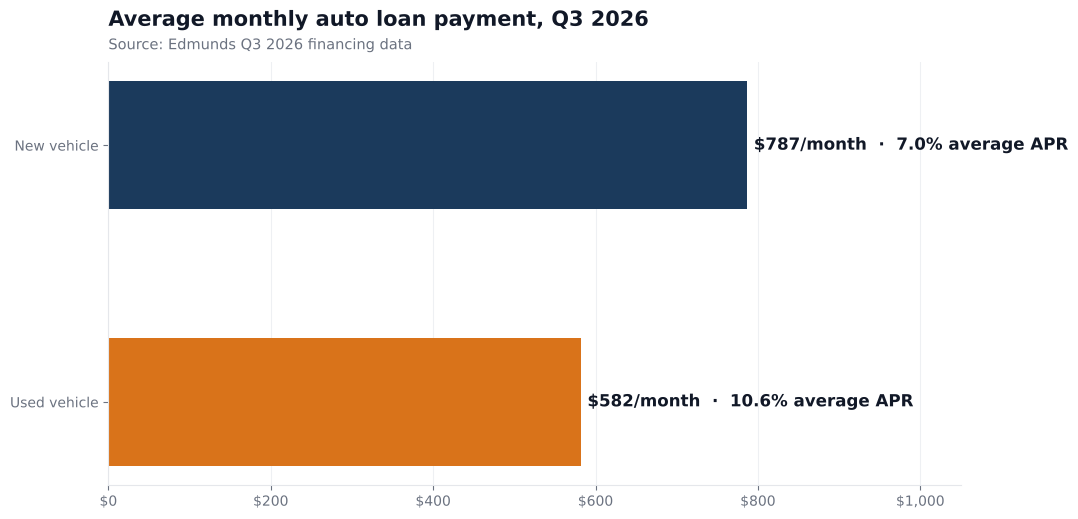
- Edmunds reports the average new-car loan in Q3 2026 carried a 7.0% APR and a $787 monthly payment; used loans averaged 10.6% and $582.
- The longer the term, the lower the payment but the higher the total interest – every time.
- A bigger down payment or trade-in equity shrinks the amount financed, which cuts both.
- How a car loan payment calculator works
- Car payment on a $28,000 loan at 6.35%
- What the average car loan looks like in 2026
- How much is a $30,000 car payment for 72 months?
- Total cost of a 5-year, $40,000 loan at 10%
- Car payment on a $17,498 car
- Trade-in equity: how much do you really need to borrow?
- How much car can you afford? The 20/4/10 rule of thumb
- 7 common mistakes when using a car loan calculator
- Frequently asked questions
How a car loan payment calculator works
Every auto loan calculator uses the same standard amortization formula:
Monthly payment = P × r ÷ (1 − (1 + r)−n)
- P = amount financed (price + taxes/fees − down payment − trade-in equity)
- r = monthly interest rate (APR ÷ 12)
- n = number of monthly payments
You don’t need to do this by hand – our auto loan calculator does it instantly and our amortization schedule calculator shows how each payment splits between principal and interest.
Car payment on a $28,000 loan at 6.35%
This is one of the most common questions we see, so here’s the answer for 48, 60, 72 and 84 months:
| Loan term | Monthly payment | Total interest | Total paid |
|---|---|---|---|
| 48 months (4 yrs) | $662.08 | $3,780 | $31,780 |
| 60 months (5 yrs) | $545.89 | $4,753 | $32,753 |
| 72 months (6 yrs) | $468.68 | $5,745 | $33,745 |
| 84 months (7 yrs) | $413.75 | $6,755 | $34,755 |

Stretching from 60 to 84 months drops your payment by roughly $132 a month – but you’ll pay $2,002 more in interest and stay in debt two extra years. Compare terms side by side with our loan comparison calculator.
What the average car loan looks like in 2026
According to Edmunds’ Q3 2026 report, new-vehicle buyers financed an average of $44,664 at a 7.0% APR over 70.5 months, paying a record $787 per month. About 25.5% of new loans had terms of 84 months or longer, and 21.2% of new-car buyers paid $1,000 or more per month. Used-car buyers averaged a 10.6% APR and a $582 payment.
How much is a $30,000 car payment for 72 months?
Another top search: “how much is a $30k car payment for 72 months.” It depends heavily on your APR:
| APR | 60 months | 72 months | Total interest (72 mo) |
|---|---|---|---|
| 5.0% (excellent credit example) | $566.14 | $483.15 | $4,787 |
| 7.0% (Edmunds new-car average, Q3 2026) | $594.04 | $511.47 | $6,826 |
| 10.6% (Edmunds used-car average, Q3 2026) | $646.30 | $564.90 | $10,672 |
The 5.0% row is an illustrative example, not a quoted market rate. The 7.0% and 10.6% rows use Edmunds’ Q3 2026 averages.
Notice how the difference between a 7.0% and 10.6% APR on 72 months is about $53 per month. Checking your credit before you shop – and getting pre-approved – is one of the fastest ways to save.
Total cost of a 5-year, $40,000 loan at 10%
For a $40,000 loan at 10% over five years, the payment is $849.88 a month. You’d pay $10,992.91 in interest, for a total of $50,992.91.
| Loan term | Monthly payment | Total interest | Total cost |
|---|---|---|---|
| 48 months | $1,014.50 | $8,696.16 | $48,696.16 |
| 60 months | $849.88 | $10,992.91 | $50,992.91 |
| 72 months | $741.03 | $13,354.41 | $53,354.41 |
Car payment on a $17,498 car
A more modest used-car purchase is easier on the budget, but the rate matters just as much. Here’s a $17,498 loan at the 2026 new and used averages:
| Loan term | At 7.0% APR | At 10.6% APR |
|---|---|---|
| 48 months | $419.01 | $448.85 |
| 60 months | $346.48 | $376.97 |
Trade-in equity: how much do you really need to borrow?
A reader-style question: “How much loan do I need for a $21,000 car if mine is worth $19,500 and I owe $14,500?” Your equity is $19,500 − $14,500 = $5,000. Applying it as a down payment, you’d finance about $16,000 before taxes and fees. At 7.0% for 60 months that’s roughly $316.82/month.
If you were underwater instead – say you owed $22,000 on that $19,500 trade – the $2,500 shortfall gets rolled into the new loan, pushing the amount financed to about $23,500 and the payment to roughly $465.33. Use our down payment calculator to see how much cash down changes the math.
6 ways to lower your car payment (without a longer loan)
- Raise your down payment. Every extra dollar down is a dollar you don’t pay interest on.
- Shop rates first. Compare banks, credit unions and online lenders before the dealer’s financing office.
- Pick a 48–60 month term if the payment fits your budget.
- Refinance later. If rates or your credit improve, test it in the auto refinance calculator.
- Pay extra principal. See the savings with the auto loan payoff calculator.
- Consider leasing if you want a lower payment and swap cars often – run the numbers in the auto lease calculator.
Before you sign, check that the payment fits your overall budget with our debt-to-income ratio calculator – lenders typically look at it closely. Not sure whether a car loan or a revolving credit line is better? Try the loan vs. line of credit calculator.
The hidden costs: tax, fees and add-ons
The number most buyers plug into a calculator is the sticker price. But lenders finance the out-the-door price, which includes sales tax, title and registration fees, and any dealer fees or add-ons you agree to. Here is a simple, illustrative example on a $28,000 car (the 7% tax and $500 in fees are placeholders – your state and dealer will differ):
| Item | Price only | Out-the-door |
|---|---|---|
| Vehicle price | $28,000 | $28,000 |
| Sales tax (7% – example only) | — | $1,960 |
| Title, registration and dealer fees (example) | — | $500 |
| Amount financed | $28,000 | $30,460 |
| Monthly payment (60 mo, 6.35%) | $545.89 | $593.85 |
| Total interest | $4,753 | $5,171 |
In this example the extra charges add about $47.96 to your monthly payment and $418 to your total interest. Always ask for an itemized, out-the-door quote before you compare loans, and enter the full amount financed into the auto loan calculator.
New vs. used: which loan is cheaper?
Used cars cost less, but they usually carry higher interest rates. Edmunds’ Q3 2026 averages were 7.0% for new and 10.6% for used loans, so the rate gap partly offsets the lower price. A hypothetical comparison:
| Scenario (60 months) | Monthly payment | Total interest | Total paid |
|---|---|---|---|
| New car, $35,000 at 7.0% | $693.04 | $6,583 | $41,583 |
| Used car, $22,000 at 10.6% | $473.96 | $6,437 | $28,437 |
The used car still wins on payment and total cost here because its price is so much lower – but the gap narrows quickly as the used car’s price rises or its rate climbs. The best approach is to compare real quotes side by side in our loan comparison calculator.
Pay it off faster: what extra payments do
Even small extra payments cut the loan short and save real money, because every extra dollar goes straight to principal. On the $28,000, 60-month loan at 6.35%:
| Extra per month | Total monthly payment | Payoff time | Total interest | Interest saved |
|---|---|---|---|---|
| None | $545.89 | 60 months | $4,753 | — |
| $50 | $595.89 | 55 months | $4,278 | $475 |
| $100 | $645.89 | 50 months | $3,891 | $862 |
| $200 | $745.89 | 42 months | $3,297 | $1,456 |
Adding $100 a month trims the loan by roughly 10 months and saves about $862 in interest. Confirm your lender applies extra money to principal (not to the next payment), then model your own plan in the auto loan payoff calculator.
How much car can you afford? The 20/4/10 rule of thumb
A popular guideline suggests putting 20% down, financing for no more than 4 years, and keeping total car costs (payment, insurance, fuel) under about 10% of your gross income. It is a rule of thumb, not a law, but it is a useful sanity check. On a $28,000 car:
- 20% down = $5,600, leaving $22,400 to finance.
- At 6.35% for 48 months, the payment is about $529.67/month – more than the $468.68 you would pay on a 72-month loan for the full price, but you would own the car sooner and pay far less interest ($3,024 total).
- Check your budget with the debt-to-income ratio calculator, and see how a bigger down payment helps in the down payment calculator.
7 common mistakes when using a car loan calculator
- Ignoring the term. Focusing only on the monthly payment hides the cost of a long loan.
- Leaving out tax and fees. See the table above.
- Guessing your APR. Get pre-approved so you are comparing real rates.
- Forgetting insurance and fuel. A newer, pricier car usually costs more to insure.
- Rolling negative equity into a new loan. It raises the amount financed and your risk of being underwater again.
- Not testing a lease. Compare buying with leasing in the auto lease calculator before deciding.
- Never revisiting the loan. If your credit improves, run the auto refinance calculator to see if a lower rate would save money.
Frequently asked questions
How is a car payment calculated?
Using the amortization formula above: your loan amount, APR and number of months determine a fixed monthly payment. Early payments are mostly interest; later payments are mostly principal.
What’s a good APR for a car loan in 2026?
Edmunds’ Q3 2026 averages were 7.0% for new and 10.6% for used vehicles. Borrowers with strong credit often qualify for less; those with weaker credit pay more.
Is an 84-month car loan a good idea?
It lowers the monthly payment, but on a $28,000 loan at 6.35% it adds $2,002 in interest versus 60 months, and you risk owing more than the car is worth for longer.
Does the calculator include sales tax and fees?
Only if you add them to the loan amount. Our auto loan calculator lets you include these so your estimate is closer to reality.
Can I pay off a car loan early?
Usually yes, but check your contract for prepayment penalties. Try extra payments in the payoff calculator.
How much should I put down on a car?
Many people aim for about 20% on a new car and at least 10% on a used one. A larger down payment lowers your payment, reduces interest and helps you avoid owing more than the car is worth.
Should I take the dealer’s financing or my bank’s?
Get a pre-approval from a bank or credit union first, then ask the dealer to beat it. Compare the APR and the total cost, not only the monthly payment.
Does a longer loan hurt my credit?
The term itself is not scored directly, but a larger balance for longer can raise your debt-to-income ratio and leave you owing more than the car is worth for more years.
- Auto Loan Calculator – estimate your payment in seconds
- Auto Refinance Calculator – see if a lower rate saves money
- Auto Loan Payoff Calculator – pay off your car faster
- Auto Lease Calculator – compare lease vs. buy
- Down Payment Calculator – how much to put down
- Loan Calculator – any loan type
- Loan Comparison Calculator – compare two offers side by side
- Amortization Schedule Calculator – see every payment
Sources & methodology
All payment, interest and total-cost figures were calculated with the standard amortization formula and assume fixed rates, equal monthly payments and no taxes, fees or add-ons unless stated. Market averages: Edmunds, Q3 2026 new car financing records. See how we calculate. This article is educational and not financial advice.