
Last updated: November 17, 2026
A balance transfer is worth it when the interest you avoid is larger than the fee you pay, and you can realistically pay the balance off while the 0% rate lasts. With the average credit card charging 22.36% on accounts that carry a balance (Federal Reserve, third quarter 2026), a typical 3% to 5% transfer fee often pays for itself within a few months.
This guide explains how balance transfers work, shows the math with a worked example, and lists the situations where a transfer does not make sense. When you are ready to test your own balance, use our balance transfer calculator.
Key takeaways
- Most balance transfer cards charge a one-time fee of 3% to 5% of the amount you move.
- The average credit card rate on accounts that carry a balance is 22.36%, so a 0% intro period can save a lot of interest.
- On a $6,000 balance, the fee is recovered in under three months of avoided interest.
- A transfer helps most if you can pay the balance off before the intro rate ends.
- The fee is usually added to the balance you transfer, so you owe interest-free money plus the fee.
What is a balance transfer?
A balance transfer moves debt from one credit card to another, usually to take advantage of a low or 0% introductory interest rate. The new card issuer pays off your old card, and you now owe that amount to the new issuer. While the intro rate lasts, every dollar you pay goes toward the principal instead of interest.
The offer comes with trade-offs. You usually pay a transfer fee, and the 0% rate ends after a set number of months. Intro period lengths vary by card, so always read the terms of the specific offer. The examples in this guide use an 18-month intro period.
How a balance transfer works, step by step
- Find a card with a transfer offer. Compare the intro rate, how long it lasts, the transfer fee, and the rate that applies afterward.
- Apply and get approved. The issuer sets your credit limit. The limit has to cover the balance you want to move plus the fee.
- Request the transfer. You provide your old card details and the amount. Some issuers let you do this during the application.
- Keep paying your old card until the transfer posts. Transfers can take days or weeks. Missing a payment on the old card in the meantime can cost you a late fee and hurt your credit.
- Pay down the new balance on a schedule. Divide the total by the number of interest-free months to find the monthly payment that clears it in time.
What the transfer fee costs
The fee is a percentage of the amount transferred. Here is what the two common fee levels cost on different balances.
| Balance transferred | 3% fee | 5% fee |
|---|---|---|
| $3,000 | $90 | $150 |
| $6,000 | $180 | $300 |
| $10,000 | $300 | $500 |
| $15,000 | $450 | $750 |
Fee ranges based on commonly advertised offers. Check the terms of each card.
Is a balance transfer worth it? The break-even math
The question comes down to one comparison: the interest you avoid versus the fee you pay. At the 22.36% average rate, a $6,000 balance costs about $111.80 in interest every month. That gives you a quick break-even check:
- A 3% fee ($180) equals about 1.6 months of interest.
- A 5% fee ($300) equals about 2.7 months of interest.
If you would need more than that to pay off the card anyway, the transfer saves money. If you could clear the balance in two or three months, the fee may cost more than the interest you would have paid.
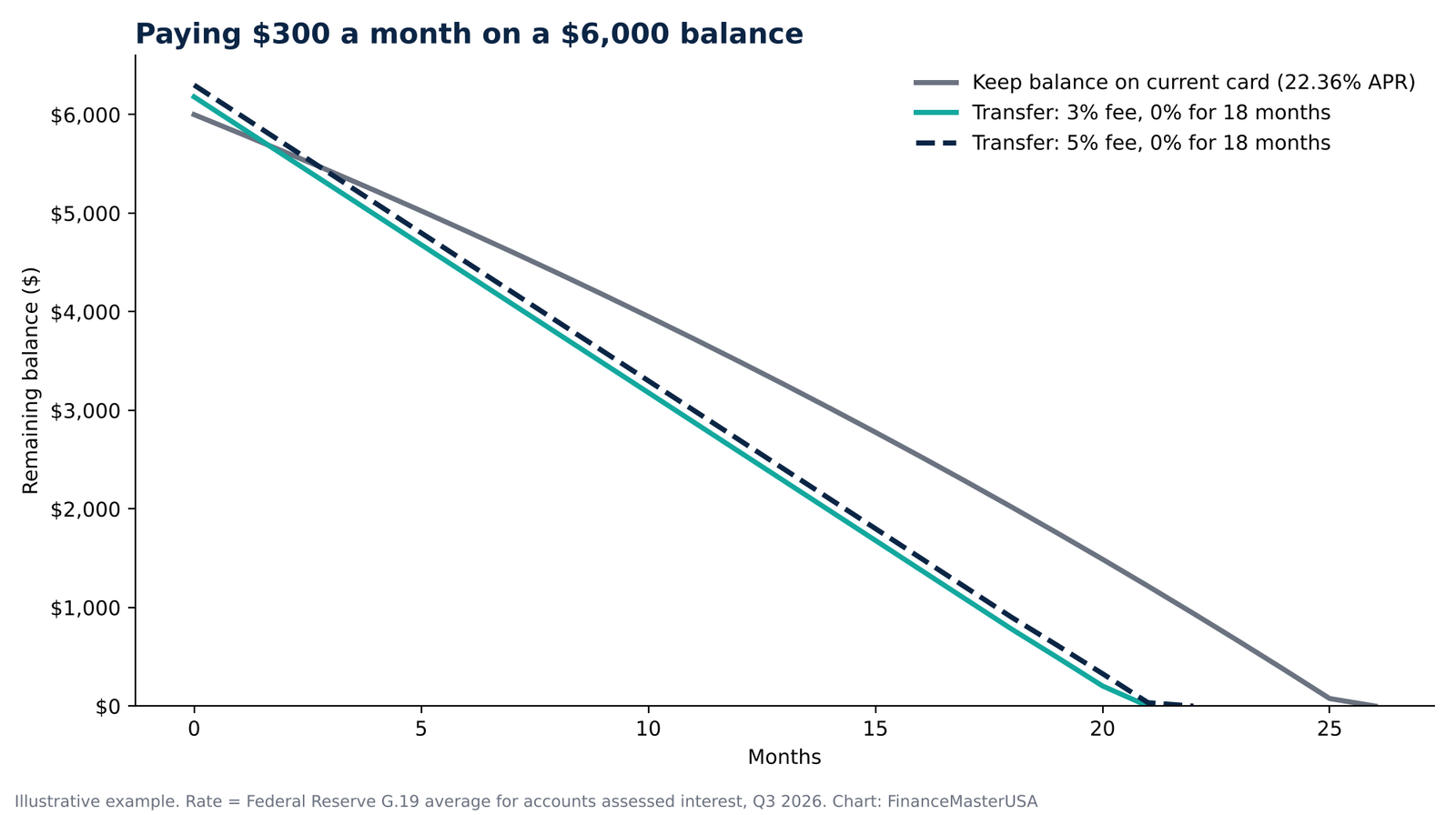
Worked example: $6,000 balance, $300 a month
Suppose you owe $6,000 and pay $300 a month. We compare three paths using the 22.36% average rate on the current card, and an 18-month 0% offer on the new card. The fee is added to the transferred balance.
| Option | Months to pay off | Interest paid | Transfer fee | Total cost |
|---|---|---|---|---|
| Keep the balance (22.36% APR) | 26 | $1,577.40 | $0 | $1,577.40 |
| Transfer, 3% fee, 0% for 18 months | 21 | $27.55 | $180.00 | $207.55 |
| Transfer, 5% fee, 0% for 18 months | 22 | $35.02 | $300.00 | $335.02 |
Illustrative example. Assumes a fixed $300 monthly payment, no new purchases, and that the 22.36% rate applies to any balance left after the intro period.
Even with the higher 5% fee, the transfer saves about $1,242 compared with staying put, and you are debt-free four months sooner. With the 3% fee, the savings are about $1,370. The small interest charge in the transfer rows comes from the balance left after month 18, when the regular rate applies.
What happens if you cannot pay it off in time?
The same $6,000 balance shows the risk. If you can only pay $150 a month, a 3% transfer leaves $3,480 owing when the 18-month promotion ends, and that balance then accrues interest at the regular rate. In our example, the total cost reaches $1,300.20 including the fee, and it takes 49 months to clear. That is still better than keeping the balance on a 22.36% card, which would take 75 months and cost $5,113.29 in interest at $150 a month. But the savings come mostly from lower interest in the first 18 months, and the longer you take, the more the high regular rate eats into them.
When a balance transfer makes sense
- You carry a balance on a card with a high interest rate.
- You can pay off most or all of the balance during the intro period.
- Your credit is good enough to qualify for a 0% offer and a credit limit that covers the balance and fee.
- You will stop adding new charges to the old card.
When it does not make sense
- You can pay the balance off in a few months. The fee may be more than the interest you would save.
- You keep spending. New purchases on the old card can put you right back where you started, now with two balances.
- You cannot get approved. A lower credit limit than your balance means only part of it moves.
- The same issuer holds both cards. Many issuers do not allow transfers between their own cards.
- The terms are unclear. Some offers end the promotional rate after a missed payment. Read the card agreement.
How a balance transfer affects your credit
Applying for a new card usually creates a hard inquiry, which can lower your score slightly for a short time. A new account also lowers the average age of your accounts. On the other hand, spreading your debt across more available credit can lower your credit utilization, which often helps your score over time. Keep both cards open and avoid new charges, and the effect is usually mild.
Alternatives to a balance transfer
- A personal loan. The Federal Reserve reported an average rate of 11.90% on 24-month personal loans at commercial banks in the third quarter of 2026, well below the average credit card rate. You get a fixed payment and a set end date.
- A debt payoff plan. If you have several debts, using the snowball or avalanche method can cut your payoff time. See our comparison of debt snowball vs. debt avalanche.
- Asking your issuer for a lower rate. It does not always work, but a call is free.
- Nonprofit credit counseling. A counselor can review your budget and may offer a debt management plan.
Check your own numbers
Try the calculator: Enter your balance, current rate, transfer fee, and monthly payment into our balance transfer calculator to see your total savings. To see how long your current card will take to clear, use our credit card payoff calculator.
Frequently asked questions
How much is the average balance transfer fee?
Most balance transfer cards charge a one-time fee of 3% to 5% of the amount you transfer. On a $7,000 transfer, that works out to $210 to $350. Check each offer, because fees and minimums vary.
How long does a balance transfer take?
It varies by issuer. Many transfers post within a few days to a couple of weeks. Keep making at least the minimum payment on the old card until you see the transfer complete.
Is a 0% balance transfer really free?
The interest is 0% during the intro period, but the transfer fee is a real cost, and the regular rate applies to any balance left when the period ends. The savings come from paying down principal faster, not from the debt being free.
Can I transfer a balance to a card I already have?
Sometimes, depending on the issuer and the offer. Many offers are limited to new accounts, and you usually cannot transfer between two cards from the same issuer.
Does a balance transfer hurt my credit score?
A new application usually causes a small, temporary dip from the hard inquiry. Over time, paying down the debt tends to help your score. The result depends on your overall credit profile.
Bottom line
A balance transfer is a tool, not a cure. It works when you have a plan to pay the balance down during the intro period and you stop adding to the old card. Do the break-even math, compare the fee with the interest you would pay, and make sure the monthly payment fits your budget. If you are also considering a large purchase on credit, see our guide to auto loan interest rates by credit score.
This article is general information, not financial advice. Card terms change often. Confirm current offers and fees with the issuer.