
Last updated: November 17, 2026
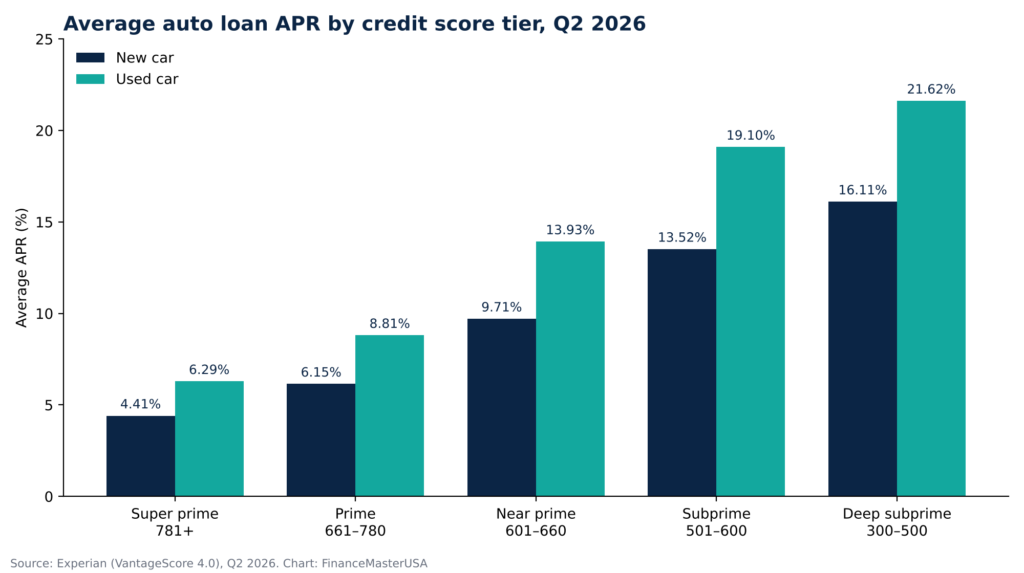
In the second quarter of 2026, the average new car loan rate was 4.41% for borrowers with the highest credit scores and 16.11% for those with the lowest. For used cars, the range ran from 6.29% to 21.62%, according to Experian. Your credit score is the single biggest reason two people buying the same car can pay thousands of dollars apart.
This guide shows the 2026 averages by credit tier, translates each rate into a real monthly payment and total interest cost, and explains what you can do to land a lower rate. You can test your own numbers with our auto loan calculator at any point.
Key takeaways
- Average new car APRs range from 4.41% (super prime) to 16.11% (deep subprime) in Q2 2026.
- Used car loans cost more at every credit tier, from 6.29% up to 21.62%.
- On a $30,000, 60-month new car loan, the gap between the best and worst tier is about $10,400 in interest.
- A longer term lowers your payment but raises the total interest you pay.
- Shopping around and getting pre-approved before you visit a dealer are the two easiest ways to lower your rate.
Average auto loan rates by credit score in 2026
Lenders group borrowers into credit tiers, and each tier gets a different range of rates. The table below uses Experian data for the second quarter of 2026, which is based on VantageScore 4.0. It also shows the average monthly payment Experian reported for each group.
| Credit tier | Score range | New car APR | New car avg. payment | Used car APR | Used car avg. payment |
|---|---|---|---|---|---|
| Super prime | 781 and above | 4.41% | $741 | 6.29% | $534 |
| Prime | 661 to 780 | 6.15% | $770 | 8.81% | $528 |
| Near prime | 601 to 660 | 9.71% | $816 | 13.93% | $555 |
| Subprime | 501 to 600 | 13.52% | $805 | 19.10% | $567 |
| Deep subprime | 300 to 500 | 16.11% | $779 | 21.62% | $570 |
Source: Experian, Q2 2026. Averages are not offers. Your rate depends on your lender and your full application.
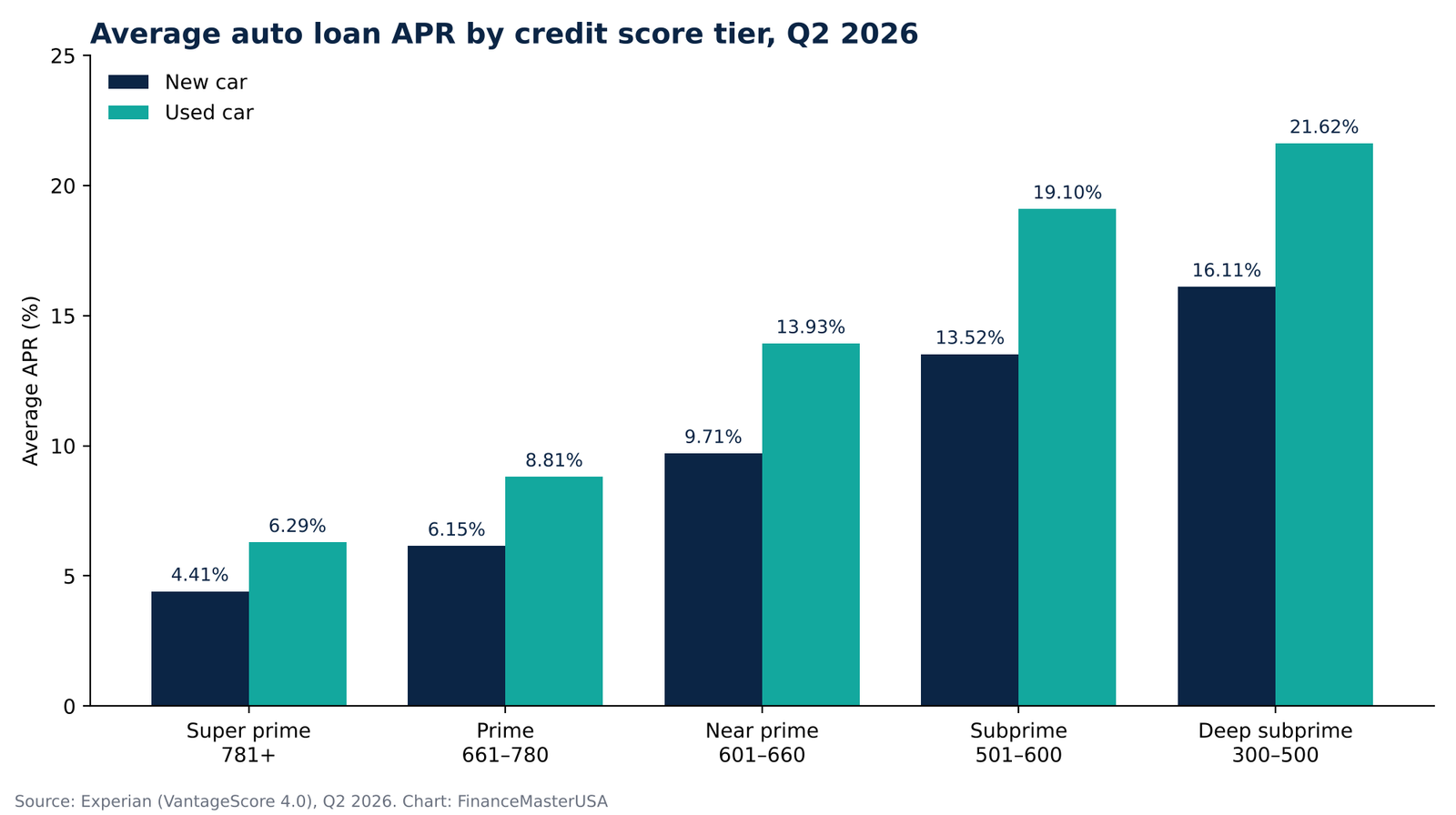
Two patterns stand out. First, used car rates are higher than new car rates in every tier, which reflects the extra risk lenders see in older vehicles. Second, the average payment does not rise in step with the rate, because each group also borrows different amounts and uses different terms. That is why the same-loan comparison in the next section is more useful than the payment column alone.
You may see other averages quoted elsewhere. The Federal Reserve’s November 2026 consumer credit release put the average rate on 60-month new car loans at commercial banks at 7.54%. That number covers a different group of lenders and borrowers than Experian’s data, so the two will not match exactly. Treat all averages as a guide, not a quote.
What a higher rate actually costs
An extra few percentage points sounds small until you see it multiplied across five years. The table below uses a $30,000 new car loan over 60 months, with the average rate for each tier from the table above.
| Credit tier | APR | Monthly payment | Total interest |
|---|---|---|---|
| Super prime | 4.41% | $558.06 | $3,483.82 |
| Prime | 6.15% | $582.08 | $4,924.73 |
| Near prime | 9.71% | $633.14 | $7,988.34 |
| Subprime | 13.52% | $690.60 | $11,436.27 |
| Deep subprime | 16.11% | $731.30 | $13,877.78 |
Illustrative calculation using standard loan amortization. Not a lender quote.
The difference between the top and bottom tier is $10,393.96 in interest on the same car and the same term. Even moving from near prime to prime saves about $3,000 over the life of the loan.
Used cars follow the same pattern. On a $20,000 used car loan over 60 months, the monthly payment runs from $389.36 at 6.29% to $548.07 at 21.62%, and total interest ranges from $3,361.52 to $12,883.95.
How lenders decide your auto loan rate
Your credit score is the headline factor, but it is not the only one. Lenders typically weigh:
- Credit history and score. Payment history, how much of your available credit you use, the age of your accounts, and recent applications all feed into your score.
- Loan term. Longer loans usually carry higher rates because the lender is exposed for more years.
- Down payment and loan-to-value. Borrowing close to the full value of the car, or more, makes the loan riskier for the lender.
- Vehicle age and type. Used and older vehicles generally cost more to finance than new ones.
- Income and debt-to-income ratio. Lenders want to see that the payment fits comfortably next to your other debts.
- The lender itself. Banks, credit unions, online lenders, and dealer financing all price loans differently.
Why the loan term changes the real cost
Stretching a loan across more months lowers the payment, which is why long terms are popular. The trade-off is more interest. Here is a $30,000 loan at 6.15%, the average new car rate for prime borrowers, over four different terms.
| Term | Monthly payment | Total interest | Total paid |
|---|---|---|---|
| 48 months | $706.62 | $3,917.56 | $33,917.56 |
| 60 months | $582.08 | $4,924.73 | $34,924.73 |
| 72 months | $499.31 | $5,950.58 | $35,950.58 |
| 84 months | $440.42 | $6,995.04 | $36,995.04 |
Going from 48 to 84 months cuts the payment by about $266 a month, but costs roughly $3,077 more in interest. Longer loans also leave you owing more than the car is worth for longer, which becomes a problem if the car is totaled or you want to sell it early. If you are weighing how much car fits your budget, read our guide on how much car you can afford.
9 ways to get a lower auto loan rate
- Check your credit reports first. You can request free reports from each of the three credit bureaus at AnnualCreditReport.com. Dispute any errors before you apply.
- Get pre-approved before you shop. A pre-approval from a bank or credit union gives you a rate to compare against the dealer’s offer.
- Compare several lenders. Apply to a few lenders within a short window. Credit scoring models generally treat multiple auto loan inquiries in a brief period as a single inquiry, though the exact window depends on the scoring model.
- Put more money down. A larger down payment lowers the amount you borrow and can improve your rate.
- Choose a shorter term. If the higher payment fits, a shorter loan usually carries a lower rate and much less total interest.
- Pay down credit card balances. Lower card utilization can lift your score quickly, sometimes within a billing cycle or two.
- Consider a co-signer. A co-signer with strong credit can help you qualify for a better rate, but they become legally responsible for the loan.
- Look at the total price, not only the payment. A low payment can hide a long term or a high rate.
- Refinance later. If your score improves or rates fall, you can refinance to a lower rate. Check for prepayment penalties first.
Run your own numbers
Try the calculator: Enter the loan amount, rate, and term in our auto loan calculator to see your monthly payment, total interest, and the effect of a bigger down payment. If you are carrying credit card debt too, compare it with our credit card payoff calculator.
Frequently asked questions
What is a good auto loan APR in 2026?
It depends on your credit tier and whether the car is new or used. Experian’s Q2 2026 averages for the top tier were 4.41% for new cars and 6.29% for used cars. Anything near or below the average for your tier is reasonable, and anything well above it is worth shopping around.
Can I get a car loan with a credit score under 600?
Yes, many lenders work with subprime borrowers, but the cost is high. Experian’s Q2 2026 averages for the 501 to 600 tier were 13.52% for new cars and 19.10% for used cars. A larger down payment, a co-signer, and comparing several lenders can reduce the cost.
Why are used car loan rates higher than new car rates?
Lenders generally price used car loans higher because older vehicles have less predictable values and carry more risk for the lender. The Experian data shows a higher used rate in every credit tier.
Will shopping for an auto loan hurt my credit score?
Each application can create a hard inquiry, which may lower your score slightly. Scoring models usually group several auto loan inquiries made in a short window as one, so comparing rates within a few days is a common approach. Your lender or the scoring company can confirm the window that applies.
Bottom line
Your credit tier sets the range of rates you will see, and the loan term decides how much of that rate you pay. Know your score, get at least one pre-approval, pick the shortest term you can afford, and test the numbers before you sign. If you also have high-interest card debt, our guide on whether a balance transfer is worth it explains one way to cut that cost.
This article is general information, not financial advice. Rates and averages change often. Confirm current terms with your lender.